Markets & references

Where we have proven ourselves

Since 2018, our teams have run [40+] projects for manufacturers in pharmaceuticals, flavours and fragrances, cosmetics and defence, from molecular screening to production. Most of our work is covered by confidentiality agreements: the references below are anonymised, the results are real.

Sectors

Six fields of application

Pharma & health

Development and de-risking of syntheses of intermediates and active ingredients, process de-risking, AI-assisted molecular screening.

Fragrances & flavours

Design of odorant molecules under constraints (olfactory profile, biodegradability, freedom to operate), sustainable synthesis routes, replacement of regulated molecules.

Materials, energy & construction

Alternatives to regulated substances, materials for energy storage, continuous processes for materials and insulation chemistry.

Fine chemicals, specialties & oleochemistry

Process intensification for specialty chemicals and oleochemical derivatives, performance improvement and footprint reduction.

Food, hygiene & consumer goods

Continuous and bio-based processes for consumer-goods ingredients: fewer solvents, fewer steps, less energy.

Defence & aerospace

De-risking syntheses of energetic-material intermediates, contributing to supply sovereignty, within programmes supported by the French defence procurement agency (DGA).

Case studies

Results measured in the field

Each case study follows the same logic: the context, the lock to unlock, our approach, and above all the results obtained. Clients are never named; the results are real.

Pharma · Continuous flow + AI control · Collaborative project

An autonomous micro-factory to produce active ingredients

The framework
The collaborative R&D project PIPAc (Intelligent Production of Active Ingredients), bringing together Alysophil, Novalix, De Dietrich and Bruker, co-funded by Bpifrance.
The ambition
To demonstrate a compact, mobile and autonomous micro-factory combining continuous flow chemistry and artificial intelligence, to produce pharmaceutical active ingredients locally and sustainably, as an alternative to batch.
The lock
Transposing a pharmaceutical synthesis from batch to continuous flow and controlling it with AI despite a partially observable process: little data, measurement noise, performance drift over time.
Our approach
Batch study then transposition to continuous flow (screening, telescoping of two steps with in-line extraction, mass balance, process flow diagram and techno-economic assessment). On the AI side, comparing several learning approaches preceded the design of a proprietary algorithm mix, incorporating uncertainty to strengthen control robustness.
The results
61%
overall yield (vs 22-38% batch)
<15min
residence time (vs hours)
2
telescoped steps
≈€171
per kg (vs ≈€301 market)

A process with no intermediate isolation and improved safety. The AI agent simultaneously optimises two conflicting objectives, yield and throughput, and stays resilient to drift and fouling of the installation.
The benefit
An economically viable process for local, sustainable production in Europe (10 t/year basis), with process know-how encoded in the control algorithm.
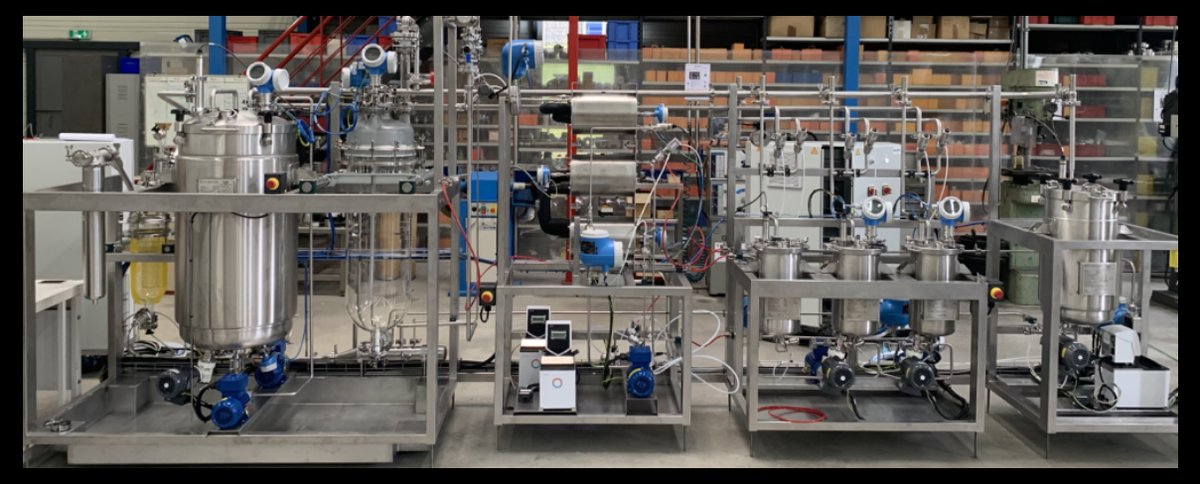
PIPAc continuous flow production line, modules mounted on mobile trolleys
PIPAc installation: a continuous, modular production line
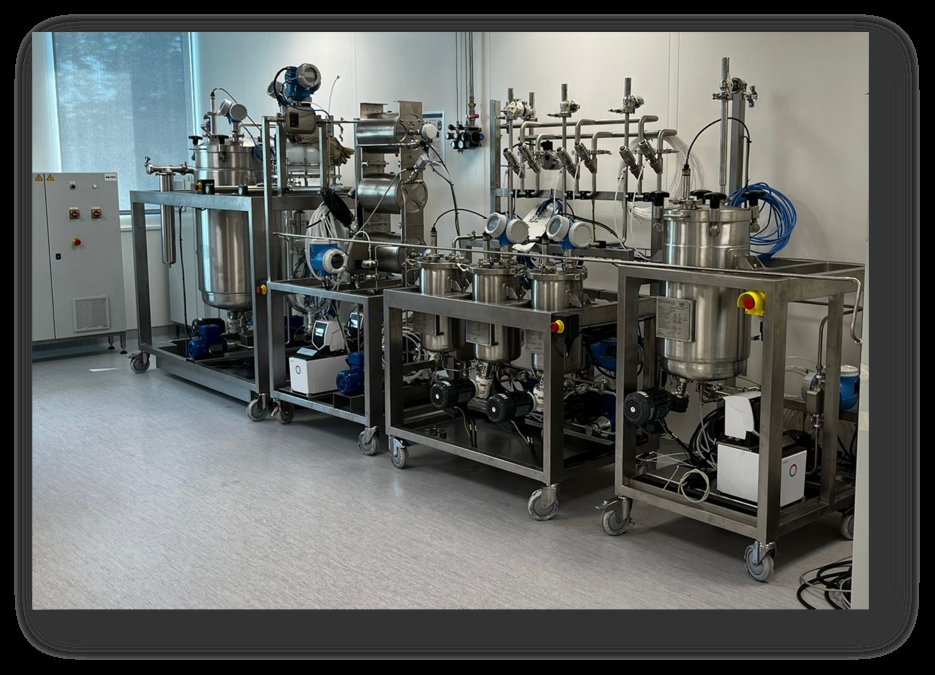
Detail of the PIPAc installation, reactors and instrumentation in continuous flow
Reactors and instrumentation, controlled in real time
Materials & insulation · AI molecular design

Designing PFAS alternatives for insulation

The client
A world leader in insulation materials, facing the upcoming regulation of PFAS used as blowing agents in its foams.
The lock
Fluorine atoms deliver exactly the desired properties, low flammability and strong thermal insulation, but at the cost of a health and environmental impact that condemns them in the long run. Finding molecules that combine the same performance without these drawbacks is a problem with a very large search space.
Our approach
With AlchemAI, we trained a series of predictive models on the twelve target properties, then generated and screened in silico new candidate molecules meeting all the criteria simultaneously.
The results
1.15M
structures evaluated
12
candidates selected
2
novel structures
12
properties optimised

Of the twelve candidates, ten are commercial molecules and two are innovative structures combining non-flammability, low environmental impact and good thermodynamic properties.

The benefit
Strong interest in the two innovative structures, performing well on all the criteria sought, which led the client to start a search for suppliers.
Defence · Insourcing a strategic molecule

Securing the supply of an energetic compound

Context

A European defence industrial group wanted to internalise the production of an energetic molecule previously bought from external suppliers.

Approach

State of the art, batch trials, continuous flow optimisation, transposition to a lab pilot, crystallisation study and industrial basic engineering.

Result

Continuous process validated at pilot scale, producing a compound meeting specifications, with an initial costed definition of the industrial installation.

Benefit

An industrialisation route securing the supply of a strategic raw material.

Defence · Continuous flow industrialisation study

Halving the effect zones of a pyrotechnic production

Context

A European defence manufacturer specialising in ammunition wanted a preliminary study and costing of a continuous flow pyrotechnic production.

Approach

Definition of the synthesis route and process (mass balance, PFD, P&ID, HAZOP, utilities), engineering, layout drawing and costing of the installation.

Result

Over 50% reduction of the effect zones thanks to continuous flow, and investment costed to ±10%.

Benefit

Clear visibility on costs (CAPEX/OPEX) and the schedule of an industrial production made safer by micro-reactors.

Your sector isn't listed here?

Let's talk about your case